The Fitness Tracker Market Is Projected to Expand Rapidly, Reaching $158.37 Billion by 2030
The Business Research Company’s The Fitness Tracker Global Market Report 2026 – Market Size, Trends, And Forecast
Press Release Disclaimer: This is a press release distributed through the XPR Media network. It has not been independently verified by our newsroom.

The Business Research Company’s The Fitness Tracker Global Market Report 2026 – Market Size, Trends, And Forecast 2026-2035
LONDON, GREATER LONDON, UNITED KINGDOM, October 12, 2026 /EINPresswire.com/ — The fitness tracker market is on a remarkable growth path, driven by increasing health consciousness and rapid technological advances. As wearable devices become more integrated into daily life, their role in personal health monitoring and fitness management is expanding. Let’s explore the current landscape, key growth factors, major players, and future prospects shaping this vibrant sector.
Fitness Tracker Market Size and Growth Expectations by 2030
By the year 2030, the fitness tracker market is expected to surpass $158 billion. This segment forms about 4% of the larger Other Services & Products market, which is projected to reach nearly $3,998 billion by the same year. When seen within the vast Healthcare Services industry, forecasted to hit $11,335 billion by 2030, fitness trackers will represent close to 1% of the total value. This underscores the growing importance of wearable health technology in the broader healthcare ecosystem.
Request A Free Sample Of The Fitness Tracker Market Report
https://thebusinessresearchcompany.com/sample_request?id=51320487&type=smp&name=Fitness%20Tracker%20Market%20Report%202026&utm_source=EINPresswire&utm_medium=Paid&utm_campaign=Oct_PR
Main Factors Fueling the Fitness Tracker Market Expansion
A key element driving this market’s rapid growth is the increasing awareness surrounding health and wellness. More individuals are embracing wearables to monitor daily activity, set fitness goals, and keep track of vital health parameters. The rising focus on prevention and self-health management, coupled with concerns around lifestyle diseases, is making fitness trackers an integral part of many people’s routines. This trend is expected to contribute about 1.5% annual growth to the market.
Technology improvements in wearable devices also play a vital role in boosting market growth. Enhanced sensors, improved wireless connections, longer-lasting batteries, and faster data processing capabilities are elevating device performance. Features such as biometric monitoring, GPS tracking, and smart health insights are engaging users more deeply and expanding application areas. These technological advancements are projected to add roughly 1.4% annual growth to the sector.
Access The Detailed Fitness Tracker Market Report Here
https://thebusinessresearchcompany.com/report/fitness-tracker-global-market-report?utm_source=EINPresswire&utm_medium=Paid&utm_campaign=Oct_PR
The growing integration of fitness trackers with digital health platforms and connected ecosystems is another important driver. Syncing wearables with smartphones, healthcare systems, and cloud-based applications provides users with personalized health data and real-time feedback. This increased accessibility and improved user experience are widening adoption globally. This factor alone is expected to contribute around 0.8% annual growth to the market.
Breakdown of Fitness Tracker Types and Leading Segment by 2030
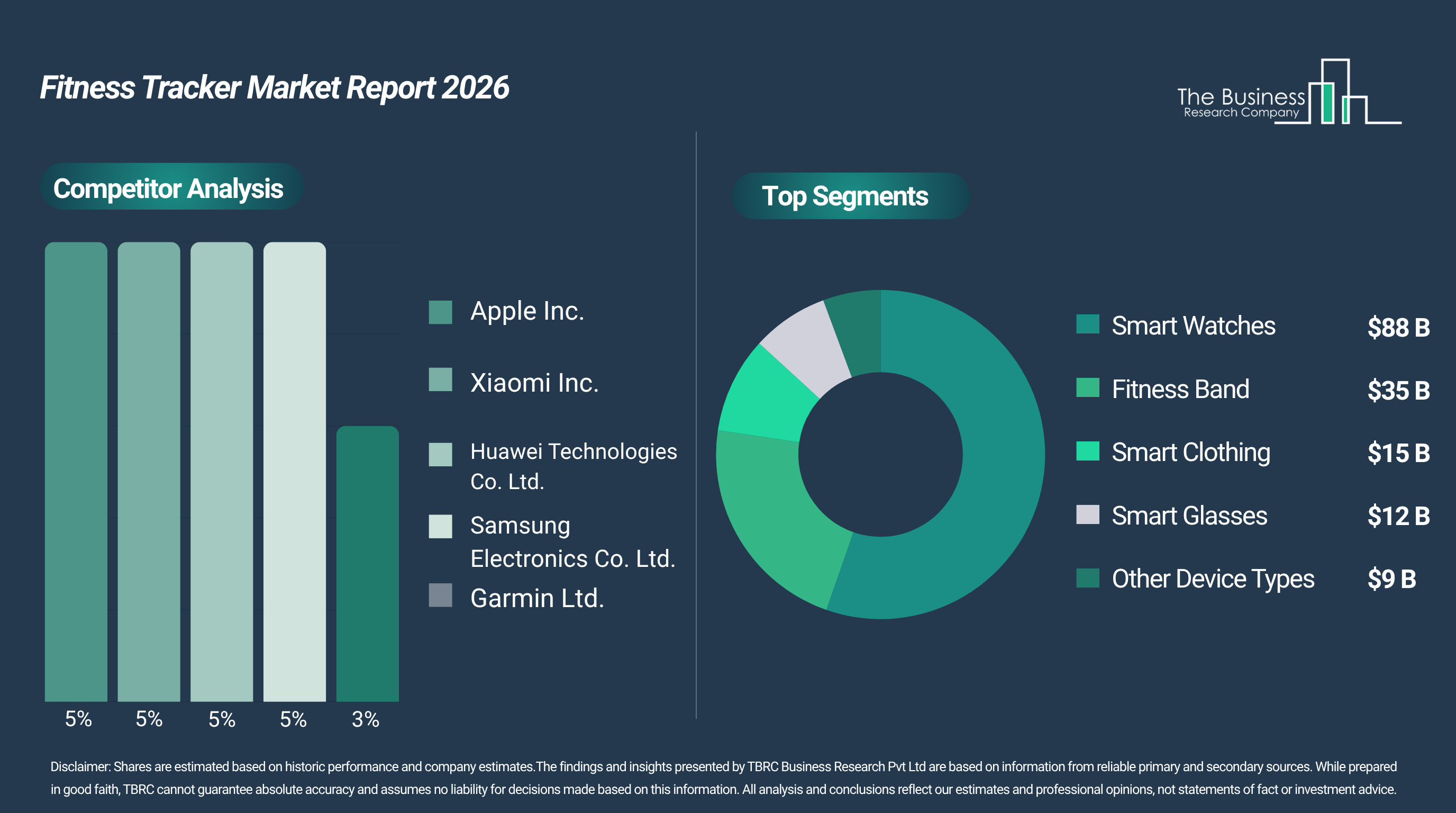
Within the fitness tracker market, products are categorized by device type, including smart watches, fitness bands, smart glasses, smart clothing, and other devices. Smart watches will dominate in 2030, making up 56% of the market or about $88 billion in revenue. Their popularity stems from multifunctionality, advanced health monitoring features, seamless smartphone integration, and strong appeal among fitness enthusiasts due to improved battery life, design, and connectivity.
Additional segmentation includes applications such as heart rate monitoring, sleep tracking, glucose measurement, as well as sports-specific tracking for running, cycling, and more. Distribution channels are classified into online retail, physical retail stores, and other avenues, reflecting diverse purchasing options available to consumers.
North America’s Leading Role in Fitness Tracker Market Growth
North America is poised to remain the biggest regional market for fitness trackers in 2030, valued at approximately $53 billion, growing from $25 billion in 2025 at a compound annual growth rate of 16%. This expansion is driven by widespread adoption of wearable health monitoring technologies across the U.S. and Canada. Factors like a strong preventive healthcare focus, incorporation of AI and advanced sensors in devices, connected real-time tracking, and substantial investments by technology firms underpin this growth.
Country-Level Insights Highlighting the USA’s Market Dominance
The United States is expected to lead as the largest national market for fitness trackers in 2030, reaching $48 billion, up from $23 billion in 2025 with a 16% CAGR. High spending on digital health initiatives, extensive use of smart wearable ecosystems, demand for personalized fitness data, and remote health monitoring capabilities are key contributors to this growth. Additionally, the popularity of sports and continuous innovations from major wearable brands help sustain strong momentum.
Competitive Landscape of the Fitness Tracker Industry
The fitness tracker sector is shaped by a mix of global consumer electronics giants and specialized wearable technology companies. These players invest heavily in developing sophisticated health sensors, AI-driven fitness analytics, longer-lasting batteries, and seamless device connectivity to enhance user experience and expand their market share. Their competitive advantage revolves around offering personalized health insights, uninterrupted biometric tracking, and integration with broader digital health and fitness ecosystems. Understanding this competitive environment helps identify areas for innovation, partnerships, and growth within this rapidly evolving market.
Leading Market Players and Their Positions
Apple Inc. emerged as the top seller in 2025, holding a 5% share of the global fitness tracker market, according to The Business Research Company. Its portfolio includes fitness trackers, smartwatches, biometric sensors, and connected wellness solutions aimed at fitness and everyday health monitoring. Other significant competitors include Xiaomi Inc., Huawei Technologies Co. Ltd., Samsung Electronics Co. Ltd., Garmin Ltd., Fitbit Inc., and others, each holding varying market shares.
The fitness tracker market is moderately fragmented, with the top 10 companies accounting for 22% of total revenue in 2025. This moderate concentration reflects the challenges of technological innovation, sensor integration, software ecosystem development, and the necessity for precision and reliability in health monitoring devices. Leading firms maintain their positions through extensive product offerings, global distribution networks, strong brand recognition, and ongoing innovation in wearable technology.
Emerging Trends Transforming the Fitness Tracker Market
One notable trend reshaping this market is the introduction of screenless fitness trackers, which offer continuous health monitoring with greater comfort and AI-driven personalized wellness insights. For example, Google LLC launched Fitbit Air in May 2026, a lightweight, screenless device designed for 24/7 passive health tracking. Its features include continuous biometric monitoring, AI-based health coaching, and a seven-day battery life, enhancing user engagement and fitness guidance.
Where the Most Significant Growth Opportunities Lie
The segments covering smart watches, fitness bands, smart glasses, smart clothing, and other device types are expected to generate the largest gains, collectively adding over $88 billion in market value by 2030. Smart watches alone are projected to grow by $54 billion, fitness bands by $13 billion, smart clothing by $9 billion, smart glasses by $8 billion, and other devices by $4 billion between 2025 and 2030. This growth is fueled by advancements in wearable technology, personalized health and fitness tracking, integration with connected devices, and innovative sensor capabilities.
Dominant Strategies Driving Market Success
Key competitive strategies in the fitness tracker market include advancing sensor technologies for higher accuracy and better performance, leveraging AI and data analytics to provide tailored health insights, expanding connected health ecosystems to facilitate remote monitoring and wellness, and integrating smart fitness features that enhance user engagement and health outcomes.
Noteworthy Companies in the Fitness Tracker Market
Prominent companies competing in this space include Apple Inc., Xiaomi Inc., Huawei Technologies Co. Ltd., Samsung Electronics Co. Ltd., Garmin Ltd., Fitbit Inc., Sony Corporation, Fossil Group Inc., Polar Electro Oy, Coros Wearables Inc., and others such as Casio Computer Co. Ltd., Timex Group USA Inc., TomTom N.V., Motorola Mobility LLC, Razer Inc., Jaybird LLC, Adidas Inc., Hexoskin, LifeBEAM Technologies Ltd., Atlas Wearables Inc., Moov Inc., Misfit Inc., Lumo Bodytech Inc., and Ambiotex GmbH.
Fitness Tracker Market Value Chain Overview
The value chain of the fitness tracker market involves a broad network of raw material suppliers, distributors, and end users. Major raw material providers include Samsung Electro-Mechanics Co. Ltd., Murata Manufacturing Co. Ltd., TDK Corporation, STMicroelectronics N.V., Infineon Technologies AG, NXP Semiconductors N.V., Texas Instruments Incorporated, Analog Devices Inc., Microchip Technology Incorporated, ams-OSRAM AG, Bosch Sensortec GmbH, Sony Semiconductor Solutions Corporation, Corning Incorporated, Nippon Electric Glass Co. Ltd., Qualcomm Technologies Inc., MediaTek Inc., Goertek Inc., AAC Technologies Holdings Inc., Luxshare Precision Industry Co. Ltd., BYD Electronic International Company Limited, Sunwoda Electronic Co. Ltd., LG Display Co. Ltd., BOE Technology Group Co. Ltd., Japan Display Inc., and E Ink Holdings Inc.
Distributors and wholesalers include Ingram Micro Holding Corporation, Arrow Electronics Inc., Avnet Inc., D&H Distributing Co., Exertis Group, Redington Limited, ALSO Holding AG, Esprinet S.p.A., ScanSource Inc., Westcon Group Inc., Exclusive Networks SA, Bechtle AG, Insight Enterprises Inc., CDW Corporation, ASBIS Enterprises PLC, Logicom Public Limited, EET Group A/S, Mindware FZ LLC, ELKO Group, Siewert & Kau Computertechnik GmbH, Compuage Infocom Limited, M Systems International Co. Ltd., and BlueStar Incorporated.
End users encompass a wide range of companies such as Apple Inc., Garmin Ltd., Fitbit LLC, Huawei Technologies Co. Ltd., Xiaomi Corporation, Polar Electro Oy, Suunto Oy, Whoop Inc., Oura Health Oy, Withings S.A., Amazfit, Zepp Health Corporation, Noise, Boat Lifestyle, Google LLC, Fossil Group Inc., Casio Computer Co. Ltd., Timex Group B.V., TomTom International BV, Decathlon S.A., Shenzhen OnePlus Technology Co. Ltd., Realme Mobile Telecommunications Corporation Limited, Vivo Communication Technology Co. Ltd., Oppo Guangdong Mobile Telecommunications Corp. Ltd., and Nothing Technology Limited.
What’s included in our 2026 market reports:
• Market attractiveness scoring and analysis
• Total addressable market (TAM) analysis
• Company scoring matrix graphics and tables
• Excel-based forecasting dashboards
• Market hotspots infographics
• Key technologies and future trend analysis
• Updated graphics and tables
Learn More About The Business Research Company
The Business Research Company (www.thebusinessresearchcompany.com) is a leading market intelligence firm renowned for its expertise in company, market, and consumer research. We have published over 30,000+ reports across 27 industries and 60+ geographies. Our research is powered by 1,500,000 datasets, extensive secondary research, and exclusive insights from interviews with industry leaders.
We provide continuous and custom research services, offering a range of specialized packages tailored to your needs, including Market Entry Research Package, Competitor Tracking Package, Supplier & Distributor Package and much more.
Disclaimer: Please note that the findings, conclusions and recommendations that TBRC Business Research Pvt Ltd delivers are based on information gathered in good faith from both primary and secondary sources, whose accuracy we are not always in a position to guarantee. As such TBRC Business Research Pvt Ltd can accept no liability whatever for actions taken based on any information that may subsequently prove to be incorrect. Analysis and findings included in TBRC reports and presentations are our estimates, opinions and are not intended as statements of fact or investment guidance.
Contact Us:
The Business Research Company
Americas +1 310-496-7795
Europe +44 7882 955267
Asia & Others +44 7882 955267 & +91 8897263534
Email: marketing@tbrc.info
Follow Us On:
LinkedIn: https://in.linkedin.com/company/the-business-research-company
Oliver Guirdham
The Business Research Company
+44 7882 955267
info@tbrc.info
Visit us on social media:
LinkedIn
Facebook
X
Legal Disclaimer:
EIN Presswire provides this news content “as is” without warranty of any kind. We do not accept any responsibility or liability
for the accuracy, content, images, videos, licenses, completeness, legality, or reliability of the information contained in this
article. If you have any complaints or copyright issues related to this article, kindly contact the author above.

Media gallery