SereneDB Launches Krummelanke: The Fastest Search and Analytical Engine Enabling the Agentic Future
As AI agents begin to outnumber the humans they work for, SereneDB releases the first production-ready database built
Press Release Disclaimer: This is a press release distributed through the XPR Media network. It has not been independently verified by our newsroom.

As AI agents begin to outnumber the humans they work for, SereneDB releases the first production-ready database built for them: ultra-fast full-text search and ultra-fast analytics, fused in one open-source, Postgres-compatible engine- designed to support the agentic-AI software ecosystem that Gartner projects will reach $985 billion in spending by 2030.
BERLIN, GERMANY / ACCESS Newswire / September 22, 2026 / SereneDB today released Krummelanke, the first production-ready version of its real-time search analytics database — data infrastructure designed from the ground up for the workload that will define the next decade of computing: fleets of AI agents querying massive enterprise data at machine speed. SereneDB Krummelanke is open source under the Apache 2.0 license and available now on GitHub.
The user of enterprise data is changing faster than the infrastructure beneath it
Every database in production today was designed for a human user. An AI agent fires hundreds of queries per second, around the clock — and it never works alone. Nvidia CEO Jensen Huang put a number on it at GTC in March 2026: within a decade, he expects Nvidia to run with roughly 75,000 employees “working with seven and a half million agents” — one hundred digital workers for every human one. Gartner reports agentic-AI inquiries grew more than 1,700% in 2025 and forecasts that agentic AI software spending will reach $985 billion by 2030.
“The agentic future is, above all, a data-load problem,” said Alexander Malandin, co-founder and CEO of SereneDB. “Today an AI agent is a single bee visiting a single flower. What is coming is the swarm: more agents than employees in every organization, each firing hundreds of queries a second. Infrastructure built for human users is neither fast enough nor cost-efficient enough to survive that load. The agentic future requires a new generation of database: ultra-fast search and ultra-fast analytics in one engine, where search operations are measured in nanoseconds and a question over billions of records comes back in milliseconds. One that treats agents as first-class users, withstands their scale, and reaches data wherever it lives. That is what we built, and with SereneDB Krummelanke we are putting it into production.”
Agents ask hybrid questions. Databases were built to answer half of them.
Agents — and the humans directing them — ask questions in natural language, and nearly every natural question is a hybrid: find the relevant records in messy, unstructured data, and compute over them, in one question. For forty years those have been two different industries — full-text search engines that cannot do heavy analytics, and analytical databases that cannot search — stitched together with pipelines and sync jobs. A human tolerates the seams; an agent at machine speed cannot. SereneDB’s answer is ultra-fast full-text and vector search and ultra-fast analytics in one engine — one query plan, no ETL — because much of what enterprises want from AI this decade is simply not achievable while “find it” and “reason it” live in separate systems.
Cost-efficiency by architecture
SereneDB’s search execution model is built on tiered storage economics: the frequently used hot set is served from a small local working set, while everything else lives in low-cost cloud object storage such as Amazon S3 — and remains fully searchable there. Analytics over object storage is industry standard; search over it was unsolved until now. Disk-resident vector indexes extend the same economics to AI retrieval workloads.
SereneDB can hold and query data at petabyte scale and can store and retrieve billions of vectors on a single node at high speed. One of the methods enabling these capabilities is 10x+ compression — adaptive hybrid compression, the most advanced method of packing big data for cost-efficient storage.
Half a petabyte is enough to hold a full monthly snapshot of the public web — Common Crawl’s capture of the world’s webpages. Scale-out today is via federation. Full multi-node compute over an elastic storage layer, with compute and storage separated, is on the public roadmap for next year.
“We designed the fastest search engine in the world as proven by the benchmark results we announced today. Besides the speed, SereneDB is able to shrink the expensive part of your infrastructure to the size of your hot set, while everything else sits on object storage at a fraction of the cost — and stays searchable,” said Andrey Abramov, co-founder and CTO of SereneDB. “Everyone knows how to run analytics over S3. Search over S3 is the part nobody had really solved, and it is the part that changes the economics. In a design-partner deployment, a workload that cost about $2,500 a month in infrastructure now runs at roughly a tenth of that. Our benchmarks, configurations, and methodology are public and reproducible on GitHub — don’t take our word for it, run them.”
SereneDB is Postgres- and Elastic-compatible: existing tools connect without a rewrite; migration is a replication session, not a project. Its search core, IResearch, in production development since 2014, has outperformed Lucene and Tantivy on Tantivy’s own public benchmark; full comparative benchmarks against Postgres-ecosystem, Lucene-based products, and analytical engines are published today alongside the release, open and reproducible.
The benchmark results are updated regularly — the current version is published here:
https://serenedb.com/searchbench/
SereneDB Krummelanke also treats AI agents as a new class of database user — roles and access permissions enforced at the data layer — and indexes data where it already lives, so organizations can serve agent workloads without copying sensitive data into yet another system, meeting security and data-sovereignty requirements that copy-first architectures cannot.
From adoption to production in days
Among the teams already building on SereneDB is Justee.ai, a legal AI platform that reviews contracts, HR/employment documents, and compliance materials for SMBs, founders, and in-house teams — currently U.S.-focused, expanding toward Commonwealth markets.
“SereneDB gave us something we didn’t expect to find: an insanely fast, all-in-one database that was genuinely easy to adopt. Our coding agent worked directly against SereneDB’s documentation and we had search and analytics features live almost immediately — no lengthy migration, no new query language to learn. That speed matters a lot right now, as we build out legal document analysis for small and medium businesses across the Commonwealth. We’re excited to keep growing with SereneDB as a partner,” said Max Zaykow, Founder, Justee.ai.
Zaykow’s experience points at something larger. AI has democratized software development through vibecoding — but serious applications on large volumes of data have remained professional programmers’ territory. SereneDB Krummelanke closes that gap: an enterprise-class database a coding agent can adopt directly through one MCP connection, no new query language required, putting billions of records within reach of builders whose tools topped out at spreadsheets — biotech scientists searching molecular structures across millions of papers, genomics researchers, analysts in any domain where the data outgrew the tools.
About SereneDB
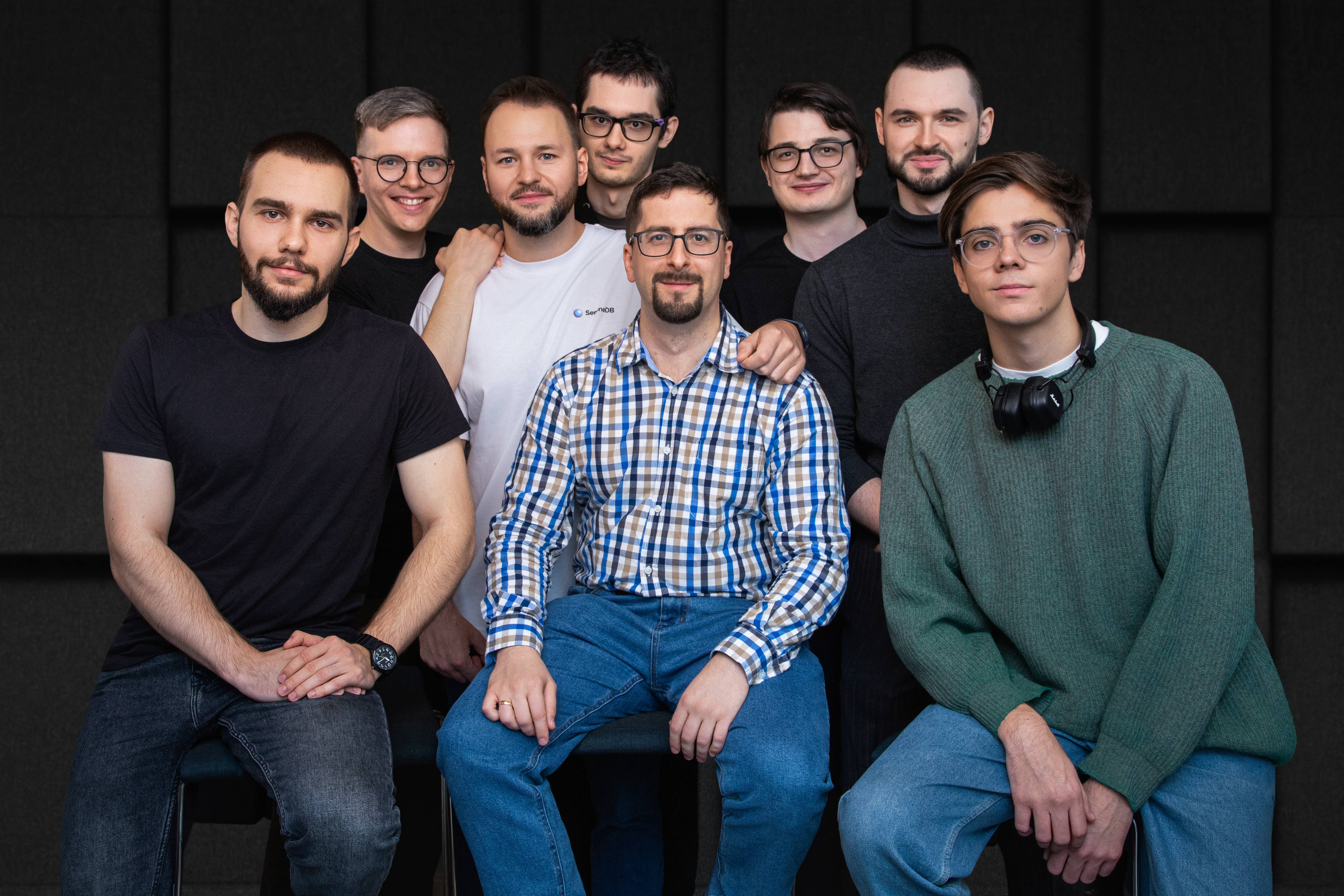
SereneDB is a real-time search analytics database: Elasticsearch-like search and ClickHouse-like analytics, tightly fused in one Postgres-compatible, open-source engine. The company was founded by Alexander Malandin (CEO), Andrey Abramov (CTO), and Valery Mironov (Principal Engineer), a team that has worked together for 16 years and has built production search technology since 2014. SereneDB is based in Berlin and raised a $2.1M pre-seed round from HTGF and Entourage in December 2025. SereneDB Krummelanke is available today, open source under Apache 2.0, at github.com/serenedb/serenedb.
Press contact:
Email: press@serenedb.com
Contact Person: Alex Malandin
SOURCE: SereneDB
View the original press release on ACCESS Newswire